|
Bob Musgrove
Biology 509 (1 unit)
Southern Oregon University
A Preliminary SEM Comparison
of Two Mount Shasta Soils
Submitted to Dr. Southworth - March
25, 2001
INTRODUCTION
What could SEM micrographs tell us
about particle morphology in two seemingly similar Mount Shasta
soil samples, one of pyroclastic origin collected from a lahar
in the Brewer Creek watershed and one of glacial, non-pyroclastic,
origin collected in the Mud Creek drainage? I suspect that examination
with the SEM will show that the Brewer Creek lahar samples contain
a significant amount of pyroclastic particles, in contrast with
the Mud Creek samples which will show significant amounts of
particles associated with glacial till deposits.
Mount Shasta is a large stratovolcano
formed over the last 100,000 years (Miller, 1981). The lower
reaches of the mountain are composed of pyroclastic, mudflow,
and fluvial material deposited in fans by successive eruptions
(Miller, 1981). Deposits from andesite lava flows, block and
ash flows, and lithic pyroclastic flows (Miller, 1981) add to
the diversity of parent material from which Mount Shasta's soils
have developed. A single study site may display numerous soils,
each originating from a specific geological event (Hill &
Egenhoff, 1976). Pyroclastic soils are significant because of
their ability to fix organic carbon at 10 to 20 times the rate
of other soils (P. Van Susteren, personal communication).
The pyroclastic Brewer Creek sample
appears to be a fine sandy loam, but tests run by the Forest
Service point toward the presence of particles with much greater
surface area than those found in sandy loam. (P. Van Susteren,
personal communication). The Brewer Creek sample tests for both
a high organic carbon content (9.76 percent) and a high capacity
to hold water, in contrast to the Mud Creek sample which tested
lower on both accounts (P. Van Susteren, personal communication).
The upper reaches of the Mud Creek
drainage are dominated by the Konwakiton and Mud Creek Glaciers.
The Mud Creek glacier was probably the origin of a large jokulhlaup
(glacial outburst flood/mudflow) in 1924 (Rhodes, 1987). Material
deposited by mud/debris flows of glacial origin dating from 1926
back to 800 CE has covered the underlying soils in Mud Creek
Canyon (Hill & Egenhoff, 1976). Previous studies in the Shasta
Mudflow Research Natural Area (41 18' N, 122 06' W) have shown
that very little weathering of mineral grains has taken place
in the soil during the previous 1200 years (Hill & Egenhoff,
1976). Research has found that surface texture on glacial till
sand grains can provide evidence of fracturing and glacial grinding
(Mazzullo & Anderson, 1987). Peter Van Susteren, Forest Service
soil scientist and manager of the RNA, has tested the Mud Creek
soil sample. He suspects that, given their source in the 1924
jokulhlaup, the particles in the sample include grains of coarse
textured sand produced by glacial action on andesite (P. Van
Susteren, personal communication).
METHODS AND MATERIALS
The non-pyroclastic, glacial till
soil sample was collected by Van Susteren from the Shasta Mudflow
Research Natural Area in Mud Creek watershed on the southern
aspect of Mount Shasta. The pyroclastic sample was previously
collected by Van Susteren from deposits in a Brewer Creek lahar
on Mount Shasta's east side.
Soil samples were sifted through a
#10 (2 mm) U.S. Standard sieve and mounted on aluminum stubs
with rubber cement. I took care to shake loose soil free from
the stubs prior to sputter coating them in the EMScope Sputter
Coater 500.
The three stubs of each soil sample
were then examined in a Hitachi-2100 SEM at magnifications of
100x to 300x. Three random screens were surveyed for each sample.
Using previously published SEM micrographs of pyroclasts (Rose,
1987) and glacial till sand grains (Mazzullo & Anderson,
1987) as guides, particles in the random samples were classified
into one of three categories: 1) particles with pyroclastic,
pumice-like morphology, 2) particles with non-pyroclastic morphology
and evidence of intense wear, and 3) particles with unclear and
indistinct morphology. I took representative random micrographs
of each sample and also made selected micrographs to illustrate
the categories in both samples.
Micrographs were acquired in bmp format
with Sigma/Mirage software running on Microsoft Windows. Results
were processed into jpg format using Adobe Photoshop software
on a Macintosh system. This lab report was produced in html format
using Adobe PageMill software.
RESULTS
Data for the Mud Creek sample shows
that the majority of the particles are non-pyroclastic. Of the
220 particles classified, 190 (86 percent) were non-pyroclastic
(Figure 4). The non-pyroclastic grains displayed evidence of
fracturing and scraping, and were not porous. The few pyroclastic
particles found in the sample also showed evidence of abrasion
(Figure 3).
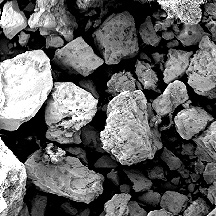
Figure 1. Representative
random micrograph of Mud Creek soil sample. Note the fractured
texture of the grains. (100x at 15 kV) |
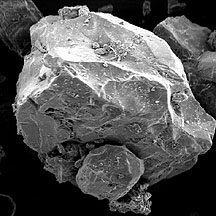
Figure 2. This
typical non-pyroclastic particle from the Mud Creek soil sample
shows evidence of fracturing. The surface of the grain is not
porous. (300x at 15kV) |
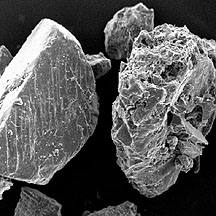
Figure 3. The
non-pyroclastic grain on the left shows evidence of scraping
and grinding. The pyroclast on the right appears to have been
similarly abraded, but with different results. This pyroclast
is one of only two found in the Mud Creek sample. (300x at 15kV) |
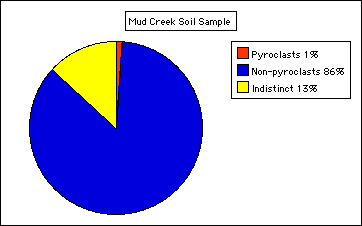
Figure 4. Particle distribution for the Mud
Creek sample. |
The Brewer Creek sample shows a majority
of particles with a pyroclastic, pumice-like appearance. These
particles appear lighter (Figure 5). The deeply vesiculated morphology
of the grain in Figure 7 is characteristic of the pyroclasts
in the Brewer Creek sample. Pyroclasts accounted for 46 percent
of the particles in this sample (Figure 8).
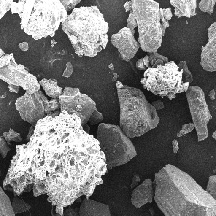
Figure 5. Representative
random micrograph of Brewer Creek sample. This is one of three
micrographs used to collect data for this sample. Note the sponge-like
morphology of the pyroclastic grains. (100x at 15 kV) |
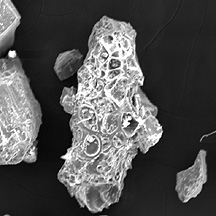
Figure 6. Pyroclastic
grain from the Brewer Creek sample. The surface is quite porous.
(300x at 15kV) |
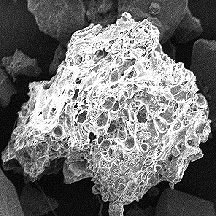
Figure 7. Brewer
Creek pyroclastic particle with vesicles. The sponge-like morphology
is typical of the pyroclasts counted in this sample. |
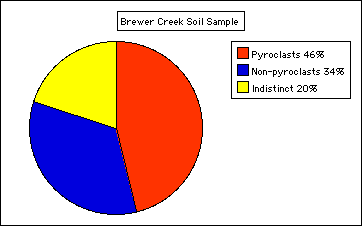
Figure 8. Particle distribution for the Brewer
Creek sample. |
DISCUSSION
The shapes and textures of clastic
particles can give us information from the geologic past about
the processes and actions that formed the particles (Marshall,
1987). The results of this lab show that a significant portion
(43 percent) of particles from the Brewer Creek samples are of
pyroclastic origin when compared with active pyroclasts documented
by Rose, 1987. On the other hand, the Mud Creek soil samples
show that the majority of observed particles (86 percent) are
similar to those associated with glacial till deposits studied
by Mazzullo and Anderson, 1987.
These lab results are consistent with
the hypothesis that the Brewer Creek soil sample would contain
a significant amount of pyroclastic particles, and that the Mud
Creek sample would show significant amounts of particles associated
with glacial till deposits.
The sponge-like pyroclasts provide
visual evidence for greater water holding capacity of the Brewer
Creek sample. Figures 1 and 2 illustrates the relative impermeability
of particles in the Mud Creek sample. The high surface-area-to-volume
ratio of the Brewer Creek sample implies an increased reactivity
that may explain the sample's 9.76 % organic carbon content.
The above conclusions are consistent with results previously
obtained by Forest Service soil tests as reported by Van Susteren
(personal communication).
Significant numbers of particles with indistinct
morphology show up in both samples. Possible explanations for
the large amount of particles not readily classified include
the presence of organic material in the samples and unclear SEM
imaging.
Suggestions for improvement in further studies include
preparing the Brewer Creek and Mud Creek samples by sonic dismemberation
with subsequent removal of water via vacuum pumping and drying
in an oven (Cormier, 1998). The above process might yield samples
free of organic material which could be imaged more clearly by
the SEM.
LITERATURE CITED
Hill M, EL Egenhoff. 1976. A California Jokulhlaup.
California Geology July 1976: 154 - 158.
Marshall JR. 1987. Clastic Particles. New York:
Van Nostrand Reinhold.
Mazzullo J, JB Anderson. 1987. Analysis of Till
and Glacial-Marine Sand Grains. In JR Marshall, editor. Clastic
Particles. New York: Van Nostrand Reinhold.
Miller D. 1981. Potential Hazards from Future
Eruptions in the Vicinity of Mount Shasta Volcano, Northern California.
Washington: United States Government Printing Office.
Rhodes P. 1987. Historic Glacial Fluctuation at
Mount Shasta, California. California Geology 40.
Rose WI. 1987. Active Pyroclastic Processes Studied
with Scanning Electron Microscopy. In JR Marshall, editor. Clastic
Particles. New York: Van Nostrand Reinhold.
|